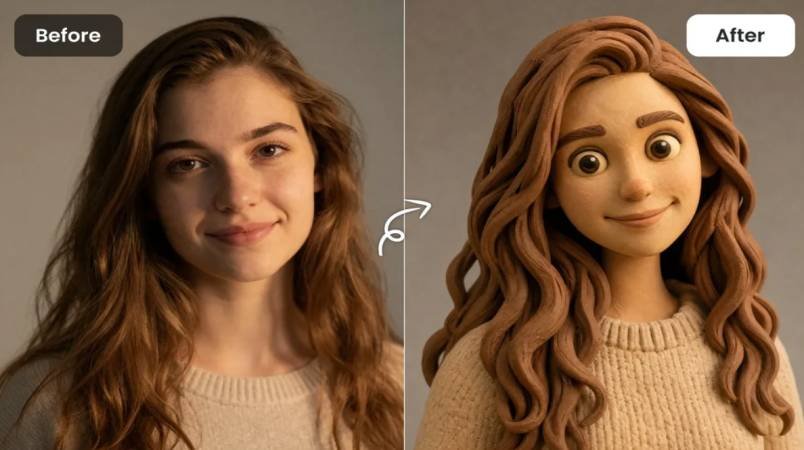
Students, teachers, designers and content creators are now using AI image creation to create visual material. With an AI image generator, you don’t need to be a pro at graphic design to create an image from a written description. Users no longer need to manually arrange objects, colors, lighting and composition, but can simply describe what they want in natural language and let an AI system interpret the request.
This technology can be useful for academic readers, e.g. for creation of presentation visuals, concept illustrations, educational diagrams, and creative project assets. Prompt comprehension is an important part of generating useful visual results in the larger picture of text-to-image technology and can be discussed in relation to GPT Image 2.5.
1. Easier to Create Visuals from Text with AI Image Generator
The biggest benefit of a text-to-image AI generator is the ability to turn plain language into visual content. The system attempts to generate details in an image, like a historical scene, a scientific concept, a classroom setting, or a product illustration, that is described by a user.
This is useful if a student knows what they want to say but does not have the professional skill to show or edit it. They can focus on describing the subject, setting, style, composition, and the important visual details instead of having to first learn complex software.
Turning Ideas into Visual Content
An AI image generator from text can make the process more accessible by allowing users to begin with an idea rather than technical design skills. The quality of the final result can depend on how clearly that idea is communicated through the prompt.
2. GPT Image 2.5 and Natural Language Image Prompting
When working with GPT Image 2.5, the quality of prompts is still a consideration. A good prompt should describe what the image should look like and give the model enough context to understand what is wanted.
You could request a modern science classroom with students looking at laboratory equipment, educational posters on the walls, natural window lighting, and a realistic academic atmosphere instead of requesting “a science classroom.”
This elaborate image prompt gives more cues for the visuals and reduces ambiguity.
Creating More Specific Image Prompts
Specific descriptions can help communicate the intended subject, environment, visual style, and composition. Users can then refine their prompts after reviewing the generated image.
3. Support Academic Projects with AI Image Generation
For students needing original visual material for presentations or educational projects, an AI image generator from text can be of help. A good prompt can produce illustrations of abstract subjects to help explain them.
A student of architecture, for example, may request a visualization of an energy-efficient classroom with solar panels, natural ventilation, indoor plants, and big windows. A biology student could also present a teaching concept with AI-generated pictures before explaining it in text.
The images generated are meant to be used as a complement to research and not as a substitute for reliable academic materials.
Using AI Images as Visual Aids
AI-generated visuals can make presentations and educational material more engaging, but important academic claims should still be supported by trustworthy sources and independently verified information.
4. Detailed Descriptions Lead to Better Outcomes
One practical lesson I’ve learned from using generative AI tools is that vague prompts yield less predictable results. Normally, detailed instructions give the system more information about the composition you want.
A good prompt might include subject matter, environment, perspective, lighting, visual style, colors, and relationships between important objects. Then, the user can edit the prompt based on the first result.
For example, if those features are important, you could add terms such as “wide composition,” “natural lighting,” “educational illustration,” or “realistic photographic style” to provide more context.
Refining Prompts Through Experimentation
Prompt refinement is often an iterative process. If the first image does not match the intended concept, users can adjust the description by adding, removing, or clarifying visual details.
5. Ethical Use of AI-Generated Images
Students and academic writers also need to consider accuracy, originality, and attribution when working with AI-generated visuals. A picture can be made to look real but also contain visual inaccuracies or details that do not depict a real-world subject correctly.
So, it’s up to you to double-check important facts when working on an academic project. The most useful function of AI-generated images is as visual aids, not as definitive proof.
Accuracy and Human Verification
AI-generated content should be reviewed carefully, especially when it is used in educational or research-related contexts. Human judgment remains important for checking whether an image accurately represents the intended concept.
6. Future of Creativity in Text-to-Image Generation
The emergence of text-to-image systems shows how natural-language interfaces are helping to break down the barriers to visual creation. Tools built on top of technologies like GPT Image 2.5 are an example of the broader trend of expressing creative goals conversationally, not just via traditional editing workflows.
Therefore, the best approach for students, researchers, and content creators is a combination of clear prompts, thoughtful editing, fact-checking, and human judgment. An AI image generator from text can be a useful tool to translate ideas into compelling visual concepts while leaving the base research and creative vision to humans. See more.