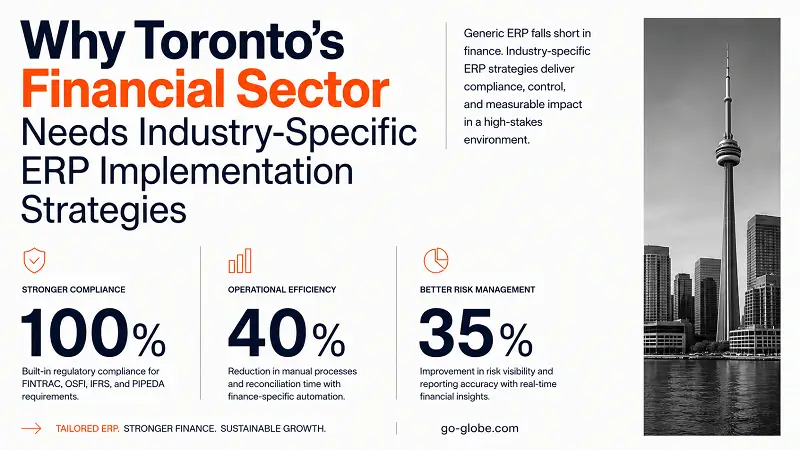
Toronto is the financial centre of Canada. This city is home to banks, insurance companies, investment companies, and fintech startups. Competition is high. Strict regulations apply. And the margin of error is not large. This is why ERP implementation Toronto financial firms choose can’t go with the automated methods having a generic fit.
Financial companies are not retail stores or manufacturing plants. They are responsible for privacy and sensitive information, intricate compliance standards, and rapidly evolving markets. A generic ERP solution for business use is insufficient. It fails to capture the specifics that are most important to finance. This blog provides clarity on why industry-specific ERP strategies are crucial and how they can be implemented successfully for Toronto’s financial sector.
What is ERP and Why It Matters for Finance?
ERP is enterprise resource planning. Business software that links various elements of a business, such as finance, HR, inventory, and operations, together into one system. An ERP integrates all the tools into a single system, whereas the use of five separate tools that do not communicate with one another is a different story.
It’s of significant importance to financial companies. Data needs to flow smoothly between departments. Reports must be factual. Compliance checks should occur automatically, not manually. A good ERP system does all this. A poor one can cause more issues than it resolves.
Because of this, implementing an ERP system in Toronto companies must be done with proper planning. Installing software isn’t enough. It’s all about creating a system that works for the financial business.
The Unique Challenges of Toronto’s Financial Sector
Toronto’s financial industry faces pressures that other industries simply don’t. Let’s break them down.
- Heavy Regulation
Financial firms in Canada must follow strict rules from bodies like OSFI, FINTRAC, and provincial securities regulators. These rules cover everything from anti-money laundering checks to data privacy. An ERP system must support these requirements out of the box, or through strong customization.
- Data Security Needs
Banks and investment firms handle highly sensitive client data. A data breach can destroy trust and bring heavy fines. ERP systems used in finance need bank-level security, not basic protection.
- Real-Time Reporting
Markets move fast. Financial firms need real-time dashboards and reports to make quick decisions. Old, slow reporting tools simply don’t work anymore.
- Multi-Currency and Multi-Entity Operations
Many Toronto-based financial firms operate across provinces or even internationally. Their ERP must handle multiple currencies, tax rules, and reporting standards without confusion.
- Integration with Legacy Systems
Many banks and insurance companies still use older software for core operations. A new ERP must integrate smoothly with these systems, not replace them overnight.
These challenges show why a generic ERP setup won’t cut it. Financial firms need a strategy built around their specific needs.
Why Industry-Specific ERP Implementation Toronto Firms Need
A generic ERP system treats every business the same way. But finance is not the same as retail or logistics. Here’s why an industry-specific approach makes a real difference.
Built-In Compliance Tools
Industry-specific ERP systems come with compliance features already built in. This includes automatic regulatory reporting, audit trails, and risk management tools. This saves time and reduces the risk of costly errors.
Financial-Specific Modules
Modules for loan management, investment tracking, or insurance claims processing are designed specifically for finance. A generic ERP would require heavy customization to achieve the same result, if it’s even possible.
Better Data Accuracy
Since the system is designed with financial workflows in mind, data mapping becomes more accurate. This reduces manual errors and improves the reliability of financial statements.
Faster Implementation Timelines
Believe it or not, industry-specific ERP systems often implement faster. Why? Because the framework is already built around common financial processes. Less time is spent building things from scratch.
Improved Scalability
As a financial firm grows, its ERP needs to grow with it. Industry-specific systems are usually built with this scalability in mind, allowing firms to add new services or expand into new markets smoothly.
Steps for a Successful ERP Implementation Toronto Businesses Can Follow
Getting ERP implementation Toronto financial firms need right requires careful planning. Here are the key steps.
Step 1: Define Clear Business Goals
Before choosing any software, define what you want to achieve. Do you need better compliance tracking? Faster reporting? Smoother client onboarding? Clear goals guide the entire project.
Step 2: Choose the Right ERP System Toronto Businesses Can Trust
Not all ERP systems are equal. Look for one built specifically for financial services, with proven success in similar companies. Avoid systems that require excessive customization just to meet basic industry needs.
Step 3: Work with Experienced ERP Consultants Toronto Firms Recommend
This step matters more than most people realize. Experienced ERP consultants Toronto businesses trust bring knowledge of both the software and financial industry regulations. They help avoid common mistakes and speed up the entire process.
Step 4: Map Out Current Processes
Before implementing new software, document how things currently work. This helps identify gaps, inefficiencies, and areas that need improvement during the transition.
Step 5: Plan for Data Migration
Moving data from old systems to a new ERP is one of the trickiest parts of implementation. Plan carefully to avoid data loss, duplication, or corruption.
Step 6: Test Thoroughly Before Going Live
Testing is not optional. Run the system through real-world scenarios before fully switching over. This helps catch problems early, when they’re easier and cheaper to fix.
Step 7: Train Your Team
Even the best ERP software fails if employees don’t know how to use it properly. Invest time in proper training so your team feels confident using the new system from day one.
Step 8: Monitor and Optimize After Launch
Implementation doesn’t end on launch day. Monitor system performance, gather employee feedback, and make adjustments as needed during the first few months.
Choosing the Right ERP Software Toronto Financial Firms Should Use
When evaluating ERP software Toronto, financial companies should consider the following key features:
- Regulatory Compliance Tools: Built-in support for Canadian financial regulations
- Advanced Security Features: Encryption, access controls, and audit logging
- Real-Time Analytics: Dashboards that update instantly for faster decision-making
- Scalability: Ability to grow alongside your business
- Integration Capabilities: Smooth connection with existing banking or insurance systems
- Cloud Flexibility: Options for cloud, on-premise, or hybrid deployment based on your needs
Choosing the right software isn’t just about features. It’s about finding a system that truly understands the financial industry’s demands.
Common Mistakes to Avoid During ERP Implementation
Even with the best intentions, financial firms can make mistakes during ERP rollout. Here are a few to watch for.
Rushing the Timeline
Trying to implement ERP too quickly often leads to poor planning and rushed decisions. Take the time needed to do it right.
Ignoring Employee Input
Your staff use these systems daily. Ignoring their feedback during planning can lead to a system that looks good on paper but frustrates users in practice.
Underestimating Data Migration Complexity
Data migration is often harder than expected. Underestimating this step can cause major delays and errors.
Skipping Proper Testing
Some companies rush to go live without proper testing. This almost always leads to bigger problems after launch.
Choosing Cost Over Fit
Choosing the cheapest ERP system instead of the one that truly fits your business needs often costs more in the long run through inefficiencies and workarounds.
The Role of ERP Consultants Toronto Financial Firms Depend On
Given the complexity involved, many financial firms choose to work with expert consultants rather than handling implementation alone. Skilled ERP consultants Toronto companies rely on bring:
- Deep understanding of financial regulations and reporting standards
- Experience handling data migration for complex financial systems
- Knowledge of industry-specific ERP platforms and their strengths
- A structured approach that reduces risks and implementation time
Working with the right consultants can be the difference between a smooth transition and a costly, stressful one.
The Future of ERP in Toronto’s Financial Sector
Toronto’s financial industry continues to grow, driven by fintech innovation, changing regulations, and increasing customer expectations. ERP systems will need to keep evolving too. Expect to see:
- Greater use of AI-driven analytics within ERP platforms
- Stronger cybersecurity features as data threats increase
- More cloud-based ERP solutions for flexibility and remote access
- Deeper integration with fintech tools and digital banking platforms
Financial firms that invest in the right ERP implementation Toronto strategy today will be better prepared for these changes tomorrow.
Final Thoughts
Toronto’s financial community is under significant stress. Strict requirements, sensitive information, and quickly changing markets require more than a standard, one-size-fits-all ERP implementation. Financial industry ERP implementation strategies provide the tools to remain compliant, efficient, and competitive.
Every step is important, from selecting the best ERP system Toronto businesses can rely on to partnering with professional ERP consultants. With careful planning, a good implementation can change the way a financial firm functions, now and for years to come.
When it comes to implementing a robust ERP solution for a specific industry, like Toronto financial firms, it’s a journey that can be significantly enhanced by partnering with a tech-savvy implementation specialist. Through these various stages, GO-Globe has assisted companies in other sectors in developing and implementing ERP strategies that boost efficiency, enforce compliance, and foster sustained growth. See more.